
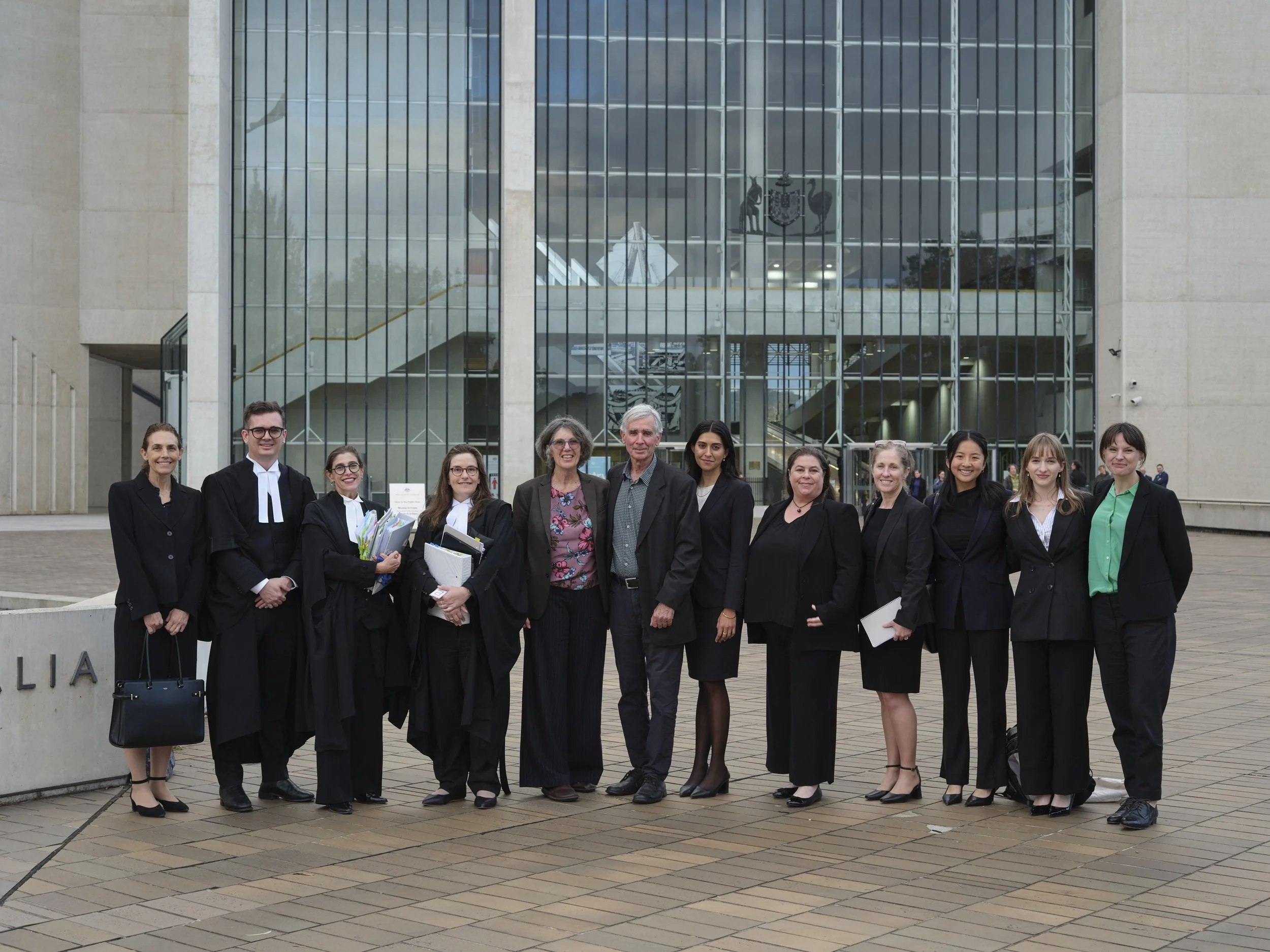
Anita O’Hart, Matthias Thompson, Naomi Sharp SC, Stephanie Patterson, Wendy Wales, Tony Lonergan, Asha Keaney, Elaine Johnson, Tracey Lynch, Georgia Zhang, Natalie Jakacic, Rachael Chick: The Johnson Legal team with counsel and Tony and Wendy from Denman Aberdeen Muswellbrook Scone Healthy Environment Group outside the High Court of Australia (credit: Zoe Lonergan)
High Court finds in favour of community group in significant Scope 3 emissions ruling
Tracey Lynch, Special Counsel, Johnson Legal
The High Court of Australia has dismissed MACH Energy's appeal in a landmark 3:2 decision confirming that, under NSW planning law, consent authorities must consider whether conditions should be imposed to minimise greenhouse gas emissions from coal mining projects, including emissions from the overseas burning of exported coal.
This case was the first climate ruling by the highest court in Australia.
In MACH Energy Australia Pty Ltd v Denman Aberdeen Muswellbrook Scone Healthy Environment Group Inc [2026] HCA 35, delivered on 7 October 2026, the High Court dismissed MACH's appeal with costs, upholding the challenge brought by the Denman Aberdeen Muswellbrook Scone Healthy Environment Group (DAMSHEG).
The case concerned the Mount Pleasant Optimisation Project in the Upper Hunter Valley, which proposed extending coal mining until 2048 and extracting an additional 406 million tonnes of coal. Approximately 98% of the project's anticipated greenhouse gas emissions were Scope 3 emissions, principally arising from the overseas combustion of exported coal.
The key findings
The obligation to consider conditions extends to Scope 3 emissions. The majority, comprising Gordon, Edelman and Beech-Jones JJ, found that the Independent Planning Commission of NSW (Commission) had failed to consider whether conditions should be imposed to minimise the project's Scope 3 emissions to the greatest extent practicable, as required by cl 2.20(1)(c) of the Resources SEPP (Gordon J [175]–[191]; Edelman J [228]–[239]; Beech-Jones J [318]).
Assessing emissions is not the same as considering conditions to minimise them. The Commission's assessment of Scope 3 emissions, including their treatment under the Paris Agreement and international accounting arrangements, did not discharge its separate statutory obligation to consider whether emissions minimisation conditions should be imposed (Gordon J [182]–[188]; Edelman J [234]–[239]).
The failure was a material jurisdictional error. There was a realistic possibility that the Commission's decision could have been different, including through the imposition of different conditions, had it complied with its statutory obligation (Gordon J [192]–[201]; Beech-Jones J [319]).
Proponents bear responsibility for identifying mitigation measures. Gordon J emphasised the proponent's responsibility to identify reasonable and feasible measures to mitigate the environmental impacts of its development. DAMSHEG's failure to propose specific emissions reduction conditions did not excuse the Commission's failure to consider whether such conditions should be imposed ([196]–[198]).
The obligation to consider a development's likely impacts. All five Justices rejected the Court of Appeal's conclusion that s 4.15(1)(b) of the Environmental Planning and Assessment Act 1979 (NSW) required a separate assessment of local climate change impacts. Gordon J explained that the obligation involves identifying the likely impacts of a development and taking those impacts into consideration. Depending on the development, relevant impacts may be local, national or global ([150]–[152]).
Why the decision matters
The decision confirms that the statutory obligation to consider emissions minimisation conditions extends to downstream Scope 3 emissions, even where those emissions occur overseas and are accounted for under international climate arrangements.
It also reinforces the distinction between assessing environmental impacts and considering measures to minimise them, while highlighting the respective responsibilities of proponents, consent authorities and community objectors.
The High Court did not require the imposition of any particular condition or determine whether the project should ultimately be approved. The proceedings are to return to the Land and Environment Court for consideration of the appropriate statutory relief.
The central message is clear: where planning legislation requires consideration of conditions to minimise greenhouse gas emissions, consent authorities cannot satisfy that obligation merely by assessing or accounting for those emissions.
Read our full analysis of the High Court's decision, including the majority's reasoning, the dissenting judgment, international climate law and implications for future mining approvals