MACH Energy v Denman Aberdeen Muswellbrook Scone Healthy Environment Group - High Court of Australia
[2026] HCA 35
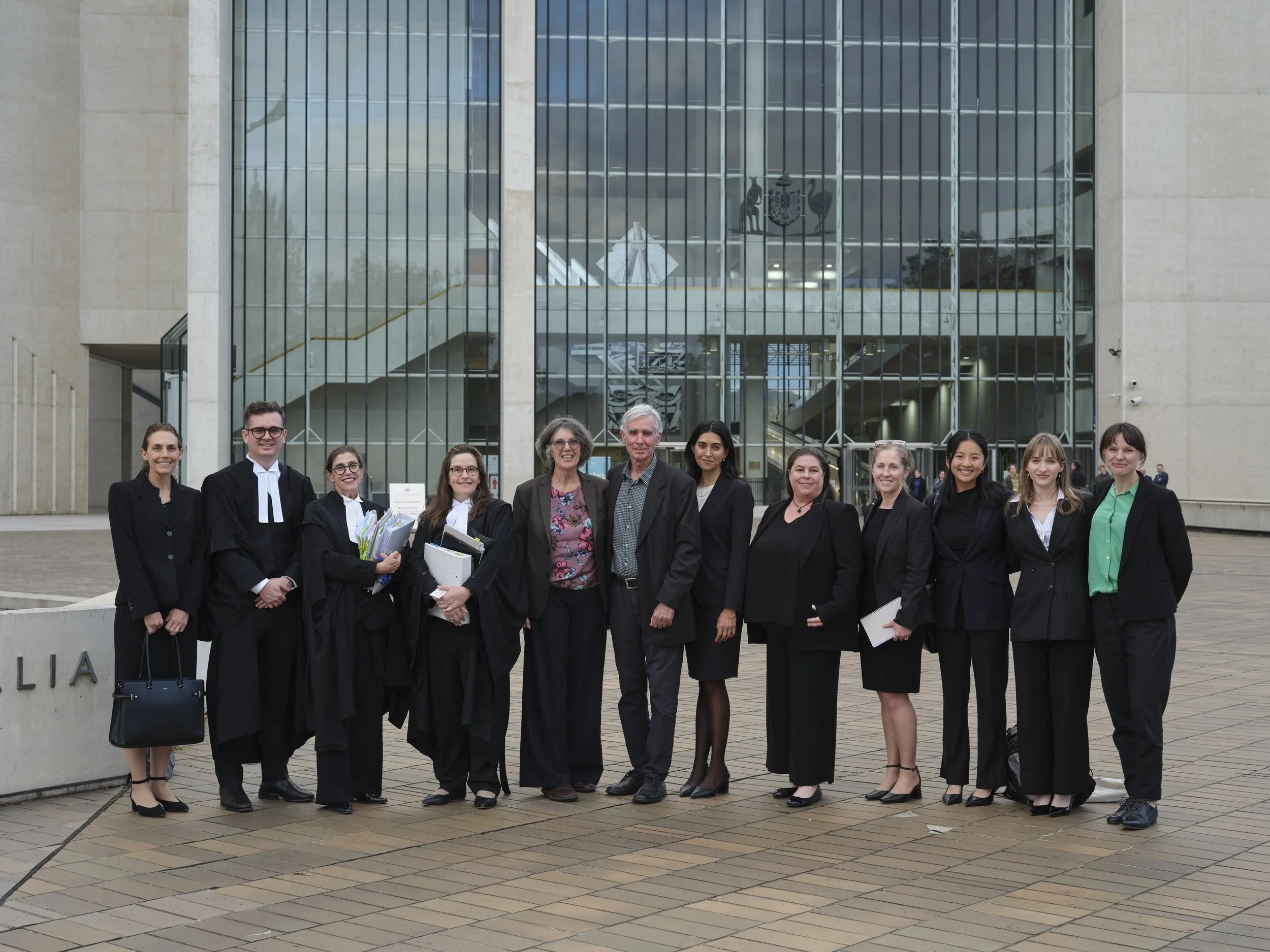
Johnson Legal with counsel and Wendy Wales and Tony Lonergan of DAMSHEG outside the High Court of Australia in Canberra (from left: Anita O’Hart, Matthias Thompson, Naomi Sharp SC, Stephanie Patterson, Wendy Wales, Tony Lonergan, Asha Keaney, Elaine Johnson, Tracey Lynch, Georgia Zhang, Natalie Jakacic and Rachael Chick). Credit: Zoe Lonergan
BREAKING: High Court of Australia delivers its first climate change judgment - and the community has won!
The decision is published on the Court’s webpage in full and in summary form
The case was won by the community on the basis that the NSW Independent Planning Commission failed to consider whether conditions should be imposed on the coal mine to minimise scope 3 (downstream) emissions arising from the coal product when it is exported.
The High Court of Australia upheld the orders of the NSW Court of Appeal overturning MACH Energy’s approval for expansion of its coal mine out to 2048. The mine is scheduled to close in 2032.
Excerpts from the High Court of Australia judgment
Gordon J
“As will be explained, the Commission was required to consider imposing conditions to minimise to the greatest extent practicable all greenhouse gas emissions, being those emissions identified in MACH's environmental impact statement ("EIS"). The Commission did not. Specifically, it failed to consider whether to impose conditions to minimise to the greatest extent practicable Scope 3 greenhouse gas emissions, which constituted 98 per cent of the project's total greenhouse gas emissions. There is no basis upon which it may be inferred that the Commission considered that issue. DAMSHEG discharged the onus of establishing that the Commission failed to do so. That error was "material" in the sense that there was a realistic possibility that the decision that was in fact made could have been different if the error had not occurred.” (at [77])
“The Commission was required by s 4.15(1)(a) of the EPA Act, read with cl 2.20(1)(c) of the Resources SEPP, to consider whether to issue the consent subject to conditions to ensure that all greenhouse gas emissions of the Project were minimised to the greatest extent practicable.” (at [172])
“In circumstances where Scope 3 emissions made up the vast majority (98 per cent) of the Project's total emissions and not only were identified but were within the "assessment boundary" for the Project, the Commission cannot be said to have discharged this obligation by considering only whether to impose conditions that minimised to the greatest extent practicable Scope 1 and 2 emissions – the remaining two per cent of the Project's emissions.” (at [178], emphasis added)
“The Commission's consideration of Scope 3 emissions was limited to an analysis of whether they were "appropriately regulated and accounted for through broader national policies and international agreements (such as the Paris Agreement)". "Scopes" is an accounting concept under those broader national policies and international agreements. There is no reference to emissions "scopes" in the UNFCCC, the Paris Agreement, or any other international law at the treaty or customary level. The impact of greenhouse gas emissions is the same, regardless of how they are categorised.119” (at [182], emphasis added)
Fn 119 See also Advisory Opinion on the Obligations of States in Respect of Climate Change (International Court of Justice, 23 July 2025); Request for an Advisory Opinion submitted by the Commission of Small Island States on Climate Change and International Law (Case No 31, International Tribunal for the Law of the Sea, 21 May 2024).
“The issue, relevant to cl 2.20(2), of how greenhouse gas emissions were accounted for or regulated is different to the issue the Commission was required by cl 2.20(1)(c) to consider, which was the minimisation of those emissions to the greatest extent practicable. Consideration of matters such as whether Australia as a country, or MACH as the proponent, could or should ultimately be responsible for all of the Project's greenhouse gas emissions (including Scope 3 emissions) did not address the question posed by cl 2.20(1)(c) of the Resources SEPP. The question the Commission asked did not discharge the Commission's obligation under cl 2.20(1)(c).” (at [183])
Edelman J
“The statutory scheme established by the EPA Act placed responsibility on MACH, as the development proponent, to propose conditions to mitigate adverse environmental effects. The Environmental Planning and Assessment Regulation 2000 (NSW) ("the EPA Regulations") required MACH's EIS to provide "a full description of the measures proposed to mitigate any adverse effects of the development … on the environment". Pursuant to the EPA Regulations, the Planning Secretary imposed requirements for the EIS to include "an assessment of the likely greenhouse gas emissions of the development" and address measures to "avoid, minimise, mitigate and/or offset the likely impacts of the development" and "an assessment of ... whether these measures … represent the full range of reasonable and feasible mitigation measures that could be implemented". DAMSHEG drew to the Commission's attention MACH's failure to propose conditions to minimise Scope 3 emissions.” (at [196], emphasis added)
“On 6 September 2022, the Independent Planning Commission of New South Wales ("the Commission") granted development consent to the Mount Pleasant Optimisation Project in the locality of the Upper Hunter Valley. That consent extended the life by 22 years, and will expand the operations, of an open cut coal mine that is owned and operated by the appellant, "MACH". The consent will permit an additional 406 million tonnes of coal to be extracted. Although a small amount of that coal will be sold on the domestic market, most of the coal will be exported. An expert, Professor Sackett, estimated that the project will be one of the 650 largest greenhouse gas emitting projects or collective human activities in the world over industries including energy, transport, agriculture, and urban development.” (at[201], emphasis added)
"The members of the Commission carefully expressed their consideration of the minimisation conditions in relation to scope 1 and scope 2 emissions, amounting to two per cent of the project's emissions. But the members of the Commission did not address that requirement with respect to scope 3 emissions, amounting to 98 per cent of the project's emissions, because they considered that those emissions would be accounted for in the countries to which the coal was exported. By focusing only upon two per cent of the project's emissions, the Commission failed in its reasons to consider whether conditions should be imposed to ensure that greenhouse gas emissions are minimised to the greatest extent practicable." (at [215])
"It suffices to say that, since questions of scope of a statutory duty and related questions of causation will depend upon the interpretation of the statutory provision, and since the relevant provision requires a wide range of matters to be considered by the Commission, there is a strong argument that matters that have a "likely impact" on natural and built environments should be broadly interpreted to include matters that make non-trivial contributions to a process that has such an impact. In other words, it would be necessary to consider any non-trivial contribution to greenhouse gases where those gases have impacts on climate change in the natural and built environments generally or upon the natural and built environments in the specific locality of the project." (at [217], obiter)
“Finally, as explained later in these reasons, the Commission's reasons reveal that the Commission was acutely conscious of the impacts of climate change both generally and in the locality. With all of those impacts as detailed by the Commission, it would be extremely curious for the Commission to have focused only upon conditions concerning two per cent of the emissions and not even to have mentioned the possibility of any conditions to minimise 98 per cent of the emissions. In this context, the obvious interpretation of the Commission's reasons is that the Commission treated it as unnecessary to consider scope 3 emissions because they would be counted in the emissions of the countries to which the coal was exported for consumption.” (at [238], emphasis added)
"The natural and irresistible interpretation of the Commission's reasons is that the Commission was distracted by the accounting concepts of the scopes into which greenhouse gas emissions are divided. That distraction meant that the Commission treated it as unnecessary to consider in its reasons conditions to ensure that scope 3 greenhouse gas emissions are minimised to the greatest extent practicable. That was an error because cl 2.20(1)(c) of the State Environmental Planning Policy (Resources and Energy) does not exclude from the ambit of minimisation conditions those emissions that might be accounted for, or even regulated, by other countries. The Commission therefore did not comply with its duty to consider in its reasons whether to impose conditions to ensure that greenhouse gas emissions are minimised to the greatest extent practicable by considering only whether two per cent of the project's greenhouse gas emissions are minimised to the greatest extent practicable." (at [239], emphasis added)
“The effects on the environment generally were discussed in the most detail in an expert report from Professor Sackett which described current climate change impacts including accelerating sea-level rise, heatwaves, more extreme wildfires, hotter days and warmer nights, intensification of the hydrological cycle, and ocean acidification. The report also described possible climate change futures, which included impacts on the environment such as increases in the intensity of hot extremes including heatwaves, heavy precipitation, agricultural and ecological droughts, increased sea levels, and high extinction risks for endemic species.” (at [254], emphasis added)
Beech-Jones J
“The scheme of cl 2.20 would be defective if, in determining a development application under cl 2.20(2), consideration was given to an assessment of all of a development's GHG emissions, including scope 3 GHG emissions, but the consent authority was only required to consider whether the consent should be issued subject to conditions to minimise scope 1 and 2 GHG emissions under cl 2.20(1)(c). Contrary to MACH's submissions, excluding scope 3 GHG emissions from any consideration of whether the consent should be issued subject to conditions to ensure that GHG emissions are minimised to the greatest extent practicable would involve a failure to comply with s 4.15(1)(a)(i).” (at [289])
“Moreover, the composite nature of the obligation described by cl 2.20(1)(c) to "consider whether or not the consent should be issued subject to conditions ... to ensure ... that greenhouse gas emissions are minimised to the greatest extent practicable" must be borne in mind. … the obligation described by cl 2.20(1)(c) is not discharged simply by considering whether or not a consent should be issued subject to conditions in order to address or appropriately regulate scope 3 GHG emissions. The "active intellectual process" required to satisfy s 4.15(1)(a)(i) insofar as it refers to cl 2.20(1)(c) is directed to considering whether the consent should be issued subject to conditions that have a sharper objective, namely to ensure that all GHG emissions, including scope 3 GHG emissions, are minimised to the greatest extent practicable.” ([290]-[291], emphasis added)
“Even if paragraph 150 (and the balance of the Commission's reasons) meant that I, like the Court of Appeal, was "persuaded that the effect of the Commission's consideration of how Scope 3 emissions would be controlled is that it cannot be inferred that the Commission failed to consider whether conditions ought be imposed on Scope 3 emissions", which I am not, that would not be fatal to DAMSHEG's contention. In that event, I would remain of the view that the Commission did not consider cl 2.20(1)(c) by considering whether the consent should be issued subject to conditions to ensure that scope 3 GHG emissions are minimised to the greatest extent practicable. As noted, that is a much sharper obligation than simply considering whether scope 3 GHG emissions are appropriately regulated or accounted for by reference to an international treaty. If cl 2.20(1)(c) had been addressed in relation to scope 3 GHG emissions, comprising 98 per cent of all GHG emissions generated by the Project, and the Commission had decided not to impose conditions, then it is to be expected that the Commission would either have referred to possible conditions and their ineffectiveness or impracticability, or at least have stated that no such conditions were proposed and the Commission had limited material available to it to address what form such conditions could take or whether the development consent should be issued subject to any such conditions.” (at [309], emphasis added)
“In many statutory contexts, if a decision maker confines themselves to addressing the contentions made by interested or affected parties, that may be sufficient to discharge the relevant statutory obligation, at least in a particular case. But that is not this case. The effect of the grant of a consent to a development application is not limited to affecting the rights and obligations of an individual or entity vis-a-vis the State. Instead, as the EPA Act recognises, the grant of a development consent, especially a consent to an application for State significant development, has the capacity to significantly affect the broader (and local) environment and all the disparate groups within it. The Commission's duty to consider cl 2.20(1)(c) was not obviated by the apparently all-or-nothing approach adopted by both MACH and DAMSHEG. The public interest loomed large over the exercise of the Commission's function.” (at [315], emphasis added)
Case history
Johnson Legal successfully defended the landmark decision of the NSW Court of Appeal in Denman Aberdeen Muswellbrook Scone Healthy Environment Group Inc v MACH Energy Australia Pty Ltd [2025] NSWCA 163, where the Court of Appeal overturned approval of the Mount Pleasant Coal Mine expansion on climate grounds. We acted for local Hunter Valley community group, Denman Aberdeen Muswellbrook Scone Healthy Environment Group (DAMSHEG).
The NSW Court of Appeal found that due to the direct causal link between the mining of coal in the Upper Hunter and climate impacts experienced by local communities, local climate impacts like bushfires, floods, heatwaves, drought and associated costs are a mandatory relevant consideration when assessing the impacts of the coalmine expansion in the locality.
MACH Energy filed an application for Special Leave to appeal the decision to the High Court of Australia. The application was granted on 4 December 2025.
Principal Lawyer Anita O’Hart of Johnson Legal is representing DAMSHEG in the High Court, defending the unanimous decision of the three-judge bench in the NSW Court of Appeal. Naomi Sharp SC, Matthias Thompson and Stephanie Patterson of counsel are appearing for DAMSHEG in these proceedings.
The matter was heard by the High Court of Australia in Canberra on 13 May 2026.
The High Court is the apex court in the Australian jurisdiction. This appeal was the first time that the High Court of Australia conducted a hearing on the issue of climate change.
Submissions were filed by MACH Energy, DAMSHEG and four institutions seeking to be heard as amici curiae (“friends of the court”).
The Court granted leave for each of the amici curiae to be heard. The Union of Concerned Scientists and Melbourne Climate Futures were heard on their written submissions and orally at the hearing on 13 May 2026. The Sabin Centre for Climate Change Law and the Centre for Climate Engagement were heard on their written submissions.
05 February 2026: Written submissions and chronology (MACH Energy - Appellant)
05 March 2026: Written submissions (DAMSHEG - First Respondent)
19 March 2026: Written submissions (The Union of Concerned Scientists - amicus curiae)
19 March 2026: Written submissions (Sabin Centre for Climate Change Law, Colombia Law School and Centre for Climate Engagement, University of Cambridge - amici curiae)
19 March 2026: Written submissions (Melbourne Climate Futures, University of Melbourne - amicus curiae)
26 March 2026: Reply submissions (MACH Energy - Appellant)
30 March 2026: Written submissions on amici curiae (DAMSHEG - First Respondent)
13 May 2026: Hearing transcript (High Court of Australia)
13 May 2026: Outline of oral argument (MACH Energy - Appellant)
13 May 2026: Outline of oral argument (DAMSHEG - First Respondent)
13 May 2026: Outline of oral argument (Melbourne Climate Futures - amicus curiae)
13 May 2026: Outline of oral argument (The Union of Concerned Scientists - amicus curiae)
The audio-visual recording of the hearing is available here